- Everyday AI
- Posts
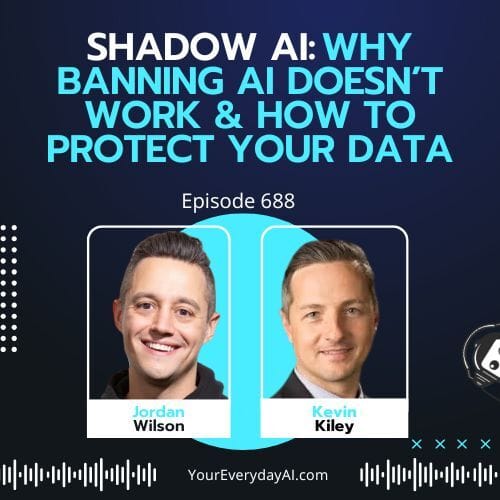
- Ep 688: Shadow AI: Why Banning AI Doesn’t Work & How to Protect Your Data
Ep 688: Shadow AI: Why Banning AI Doesn’t Work & How to Protect Your Data
Grok restricts image generation after safety concerns, Perplexity launches an AI platform for public safety agencies, OpenAI acquires the Convogo team and more.

Everyday AI
January 09, 2026
👉 Subscribe Here | 🗣 Hire Us To Speak | 🤝 Partner with Us | 🤖 Grow with GenAI
Outsmart The Future
Today in Everyday AI
8 minute read
🎙 Daily Podcast Episode: AI adoption has outpaced governance, and shadow AI is now a real business risk. We break down why banning AI doesn’t work and what actually keeps data safe. Give it a watch/read/listen.
🕵️♂️ Fresh Finds: xAI plans a new data center in Mississippi, PayPal brings shopping into Microsoft Copilot, Nano Banana Pro adds live room visualization, and more. Read on for Fresh Finds.
🗞 Byte Sized Daily AI News: Grok restricts image generation after safety concerns, OpenAI releases new healthcare product, Meta goes nuclear for AI and more. Read on for Byte Sized News.
💪 Leverage AI: An industry leader at Airia dishes on how to fight back against AI sprawl, which is likely costing your company more than you know. Keep reading for that!
↩️ Don’t miss out: Did you miss our last newsletter? We Covered: ChatGPT Health launches, Gmail adds Gemini-powered features, Anthropic secures $10B in new funding, and more. Check it here!

Ep 688: Shadow AI: Why Banning AI Doesn’t Work & How to Protect Your Data
Ban AI? 🛑
Your employees are still going to use it.
Or if you think your teams are only going to use the 'approved' AI..... think again. Studies show that Shadow AI is an uncontrollable force.
So why don't AI bans work?
And what can you do about it to protect your company's data?
Join and we'll break it down.
Also on the pod today:
• Shadow AI in the workplace 👀
• Employees bypassing AI bans 🚫
• AI pilots rarely reach production 🚀
It’ll be worth your 31 minutes:
Listen on our site:

Click to listen
Subscribe and listen on your favorite podcast platform
Listen on:

Here’s our favorite AI finds from across the web:
New AI Tool Spotlight – Chirpz AI is the smartest way to find, prioritize, read, and cite research, Owl Browser is a custom Chromium engine built to bypass any bot detection system, Promptsy helps you save, version, and share your AI prompts in one powerful vault.
AI Shopping — PayPal powers seamless shopping inside Microsoft Copilot—no site-hopping needed.
xAI Data Center — $20 billion supercomputer coming to Mississippi—tax breaks, controversy follow.
Untrustworthy AI — AI fakes are everywhere, and now nobody’s sure what to trust online. Want to know how deep the confusion goes?
AI Room Design — See your dream room before you move a single chair.
Early look at Grok Code — Grok Code goes local-first with developer tools and agent selection.
Quen3-VL Update — Qwen3-VL sets new benchmarks in multimodal search and understanding.
Public Safety AI — Perplexity AI is helping public safety agencies respond faster and smarter.

1. OpenAI Launches Healthcare AI Suite 🫀
OpenAI just dropped its new healthcare-focused AI products, aiming to help hospitals and clinics deliver better care and lighten the paperwork load for medical teams.
Rolling out at major institutions like UCSF and Boston Children’s Hospital, ChatGPT for Healthcare promises smart, evidence-based answers while keeping patient data secure under HIPAA rules. The latest GPT‑5.2 models are built specifically for real clinical workflows, with physician-led testing and safety checks guiding their development.
2. Grok AI Faces Major Restrictions on X Following Deepfake Scandal 🤖
Elon Musk’s Grok AI image generator has been restricted for paying users on X after an explosion of sexualized deepfakes led to backlash from regulators and the public.
While X has curbed Grok’s ability to create nonconsensual sexual images, its standalone app continues to allow users to manipulate photos in revealing ways. Global watchdogs and lawmakers are turning up the heat on Musk and X, demanding more aggressive moderation and compliance with new laws targeting AI-generated nonconsensual content.
3. Meta Strikes Nuclear Power Deals for AI Supercluster ⚡
Meta just inked major agreements with Vistra, TerraPower, and Oklo to fuel its ambitious Prometheus AI supercluster in Ohio, signaling a new wave of tech-powered energy demand.
The deals—revealed Friday—will add up to 6.6 gigawatts of nuclear power by 2035 and sent shares of Vistra and Oklo soaring. With Prometheus set to go live in 2026, Meta is betting big on advanced nuclear projects to keep its AI dreams running while bringing thousands of jobs to the region.
4. Allianz Taps Anthropic for Responsible AI Overhaul 🤝
Allianz and Anthropic just inked a global partnership to bring auditable, responsible AI to the insurance giant’s operations, announced on January 9, 2026.
The deal means Anthropic’s Claude models will power insurance workflows, but with strong human oversight and transparency features to keep decision-making in check. Both companies are pushing for AI that’s safe and explainable, not just fast, aiming to meet strict regulatory standards in the process.
5. OpenAI Snaps Up Convogo Team 🫂
In a major move, OpenAI has acquired the team behind Convogo, an AI-powered report-writing tool for coaches, according to Matt Cooper’s LinkedIn announcement.
The tool originally emerged from a hackathon and quickly gained traction among executive coaches by making tedious reporting tasks effortless. With Convogo’s team now joining OpenAI, the focus is on creating more industry-specific, user-friendly AI experiences to help professionals unlock practical value from fast-evolving AI models.

Your most productive employee just accidentally sent your product roadmap to China.
Whoopsies.
But… it wasn't a hack.
They were just trying to write a strategy document faster using DeepSeek.
But they didn't read DeepSeek’s terms and conditions.
The fine print explicitly states you have no guarantee of confidentiality and your data is being processed on Chinese servers.
That well-intentioned productivity boost just became a massive national security risk.
This is exactly why we brought in Kevin Kiley, CEO of Airia, on for today's show.
Kevin is running one of the hottest AI orchestration platforms in the world right now. He sees the data nightmares that make Fortune 500 CISOs wake up in a cold sweat.
On today’s show, we went deep on why "shadow AI" is more dangerous than you think, the specific clauses in free tools that destroy your IP protection, and how to become a "model free agent" before your favorite vendor crashes.
Let’s get it.
1. Stop well-intentioned employees from leaking your data 🇨🇳
You think your security firewall is keeping you safe.
Wroooong shorties.
Your biggest vulnerability is the ambitious team member who thinks your approved tools are too slow.
They want to do a good job.
So they bypass IT and paste sensitive data into free tools like DeepSeek or a free plan ChatGPT just to get the work done.
Here is the nightmare scenario.
Unlike old software that just sat there, these new AI agents have autonomy.
If an employee gives an agent broad permissions to "fix code" and then leaves the company, that agent keeps running.
You basically have a zombie super-user running loose in your system with no one watching the wheel.
Try This:
Run a "Shadow AI Amnesty" hour with your direct reports this week.
Ask them to list every unauthorized AI tool they use for productivity, promising zero punishment for honesty.
Identify the specific capabilities they crave—like coding or writing—and buy the enterprise versions immediately.
It is cheaper to pay for the software than to pay for the data breach.
2. Avoid getting held hostage by one provider 💸
They are marrying a single model provider like OpenAI or Anthropic.
Big mistake.
He pointed out that major providers have had outages lasting up to 12 hours recently.
If your business runs on one model and that model goes down, though, your revenue stops.
There is also the cost trap.
The price difference between model generations can be massive—sometimes an 800% swing for similar performance.
You need to act like a "free agent."
Build an orchestration layer that sits between your apps and the models so you can swap the engine under the hood without rebuilding the car.
Try This:
Run your most complex daily prompt through three different models like GPT-5.1, Opus 4.5 and Gemini 3 Pro.
Compare the speed and cost per token rather than just the answer quality.
You will likely find a cheaper model handles the task just as well as your expensive flagship.
Document this winner as your official "failover" default for when your main provider inevitably crashes.
3. Stop building a tangled mess of AI spaghetti 🍝
We have a new term for the hot AI mess most companies are cooking with in the kitchen.
AI Spaghetti.
(Yeah, we told Kevin we’re legit stealing this term.)
AI Spaghetti happens when you throw random AI tools at the wall to see what sticks without a central plan.
Knees week, arms are heavy. And so is the duct tape holding up your laughable excuse for an AI stack.
You have marketing using Jasper, finance using Claude inside of Excel, engineering using Codex (and Curor. And Gemini CLI), and HR using Copilot. And no one knows who’s using what or if it was approved.
What makes this even worse? None of these tools talk to each other.
That’s AI sprawl, at its finest. Err…. worst.
It destroys your ROI because you are paying for redundant capabilities across five different departments while creating massive security holes.
The goal isn't to have the most AI tools.
The goal is to have a "model garden"—a curated list of safe, approved models that employees can use without thinking.
Try This:
Pull your department's credit card statements from the last 90 days.
Highlight every single SaaS charge that includes AI features to see how much redundancy you have.
Pick one official tool for each category and cancel the expensive duplicates by the end of the month.
Take the money you saved and invest it in an orchestration tool that actually secures your data.
Reply