- Everyday AI
- Posts
- Ep 694: ChatGPT ads incoming, Gemini gets personal with you and official with Apple and more AI News That Matters
Ep 694: ChatGPT ads incoming, Gemini gets personal with you and official with Apple and more AI News That Matters
OpenAI drops receipts on Musk, Notion may be updating its agentic offerings, ChatGPT Go goes global and ads announced.

Everyday AI
January 19, 2026
👉 Subscribe Here | 🗣 Hire Us To Speak | 🤝 Partner with Us | 🤖 Grow with GenAI
Outsmart The Future
Today in Everyday AI
8 minute read
🎙 Daily Podcast Episode: OpenAI moves toward ads, Google officially teams up with Apple, and new AI agents begin reshaping how work actually gets done. Here’s what changed and why it matters. Give today’s show a watch/read/listen.
🕵️♂️ Fresh Finds: Veo 3.1 Adds multiple Photo-to-Video Generation, Claude Debuts Customizable Sidebar, Google Studio Introduces Design Mode and more Read on for Fresh Finds.
🗞 Byte Sized Daily AI News: OpenAI drops receipts on Musk, Notion may be updating its agentic offerings, ChatGPT Go goes global and ads announced, Read on for Byte Sized News.
💪 Leverage AI: AI companies just rewired the internet’s business model. From paid training data to ads inside ChatGPT, the race for control, compute, and customers just escalated fast. Keep reading for that!
↩️ Don’t miss out: Miss our last newsletter? We covered: ChatGPT brings apps and GPTs together, Wikipedia strikes huge AI deal, Microsoft's push in AI and education, and more Check it here!

Ep 694: ChatGPT ads incoming, Gemini gets personal with you and official with Apple and more AI News That Matters
Welp. That was wild. 🤪
Even though we didn't get a major new AI model, the entire AI landscape just shifted.
Google got official with Apple.
ChatGPT is bringing ads to free (and paid users)
Anthropic rolled out what I think will be the future of work
And Gemini can now get VERY personal.
Did you miss anything? We'll get you caught up.
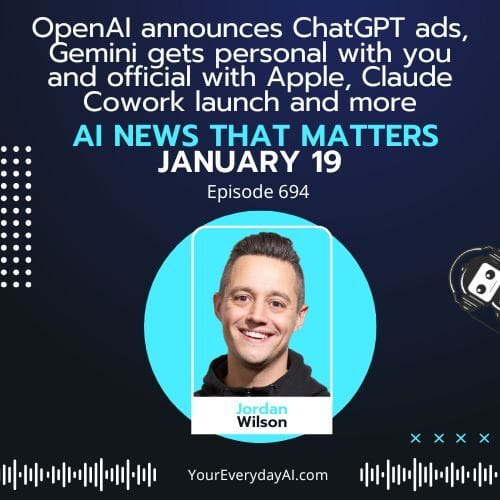
Also on the pod today:
• Wikipedia signs AI licensing deal 📚
• ChatGPT ads officially incoming 🛑
• Google powers new Apple Siri 🍏
It’ll be worth your 33 minutes:
Listen on our site:

Click to listen
Subscribe and listen on your favorite podcast platform
Listen on:

Here’s our favorite AI finds from across the web:
New AI Tool Spotlight – OS Ninja is The Smartest Way to Explore & Learn Open Source, 21st Fund Finds grants, credits, and equity-free investments with the power of Agentic AI, flins is a Universal skill and command manager for AI coding agents
Google Studio Design Mode — Google’s AI Studio is adding click-to-edit design tools. Ready to see what you can change?
Anthropic Knowledge Chat — Claude is merging chat with Cowork and smarter knowledge bases. See how your workflow could change.
Claude Customizable Commands — Claude’s new "Customize" sidebar will let you manage skills, connectors, and custom commands.
Veo 3.1 Photo To Video — Swap reference images in Veo 3.1 and watch your videos transform. The results might surprise you.
AI For Self Empowerment — AI is advancing fast, but most people aren’t using its full potential yet. See how “capability overhang” could mean big opportunities are still up for grabs.
Restore Old Photos — AI can bring your old photos back to life, but it’s not always perfect. Find out what happens when you let it try.

1. ChatGPT Go Goes Global 🌎
OpenAI has launched ChatGPT Go worldwide, making its most affordable AI subscription available everywhere ChatGPT operates, just months after debuting in India.
Priced at $8 per month in the US, Go sits alongside the more robust Plus and Pro tiers, offering expanded access to OpenAI’s latest GPT-5.2 Instant model for millions of users. The company will soon test ads in both the free and Go plans to keep them budget-friendly, while higher tiers remain ad-free.
2. OpenAI Drops Receipts on Elon Musk Power Struggle 🏭
The OpenAI vs. Elon Musk saga hit a new level as internal documents reveal Musk pushed for control over OpenAI before walking away when founders refused, contrary to his public claims. The disclosures show Musk favored a hybrid nonprofit-for-profit setup—now the structure he’s suing over—and that founders were transparent about their intent to raise billions outside his orbit.
The filings highlight how Musk wanted to fold OpenAI into Tesla and sought equity and control, but left after being told no, later launching his own AI company and turning hostile. With the original team now flush with funding and Musk ramping up legal attacks, this twist underscores just how high the stakes are in the race for artificial intelligence dominance.
3. ChatGPT to Begin Testing Ads for US Users 📰
OpenAI just announced it will start showing ads in ChatGPT for logged-in adult users in the US, marking a major shift for the popular chatbot as it seeks new revenue streams.
The company is also launching a new $8 "Go" subscription tier with more features but will still display ads to those subscribers, while pricier plans and business customers remain ad-free. OpenAI promises ads won't influence chatbot answers and says users can opt out of personalized ads, aiming to calm privacy concerns.
4. AI Investment Set to Skyrocket by 2030 🚀
IBM’s latest global study reveals a massive shift in executive priorities, with artificial intelligence spending expected to surge 150% and pivot from basic efficiency to powering innovative growth.
Nearly eight in ten leaders surveyed believe AI will drive significant revenue in just four years, but most admit uncertainty about where that money will actually come from. Companies are betting big on smarter, integrated AI—despite lingering fears about tech not syncing with core business needs—and say productivity gains will be reinvested to fuel future growth.
5. Notion Unveils Ambitious AI Automation Upgrades 🌟
Notion is reportedly ramping up its Custom Agent platform, pushing deeper into team automation with new integrations for Slack, Notion Mail, and Notion Calendar. The company is racing to make its agents the command center for modern workflows by adding support for cross-app triggers, external automations, and advanced AI co-editing features.
Upcoming tools like Workers and third-party connectors signal a major leap toward letting organizations build and run expansive automations, from project management to finance. With these rapid-fire updates, Notion is positioning itself as a formidable hub for AI-powered productivity, aiming to outpace rivals in the race for smarter workplace tools.

1. Wikipedia Finally Got Paid (By Everyone) 📚
What do large language models need more than anything else?
Training data.
The Wikimedia Foundation announced landmark licensing agreements with top AI companies this past week. They signed deals with Amazon, Meta, Microsoft, Mistral, and Perplexity. These tech giants can now access Wikipedia's data through a new paid Wikimedia Enterprise platform.
No more sketchy web scraping.
These agreements replace the old method of scraping the open web. Now, companies get structured, machine-readable data delivered via specialized APIs. This covers over 65 million articles in more than 300 languages.
The enterprise platform offers real-time updates and snapshots. This helps models stay current with live edits while reducing the need to clean up raw and messy data.
Wikimedia aims to offset rising infrastructure costs caused by aggressive AI scrapers. Plus, this move avoids litigation by treating factual content as paid data rather than copyright battles.
What it means: Wikipedia was basically the original large language model.
Now they are formalizing that role.
It is lawsuits, partnerships, or bankruptcy for media companies. There is no third option. This deal secures Wikipedia's future while feeding the AI beast.
2. Apple Officially Teams Up With Google Gemini 🤝
It is officially official.
In a joint statement from both companies, Apple announced a significant multi-year partnership with Google to power some of Apple's most important AI services. This includes a much more personalized Siri.
They will be using Google Gemini's models.
This move marks a massive shift in Apple's strategy. They tried to do it themselves for four years. They promoted Apple Intelligence. It didn't really work.
Now they are calling in the big guns.
Apple will rely on Gemini to enhance services, marking the first time Apple has used Google's foundational technology in its ecosystem. Financial terms were not disclosed, but past agreements have been valued in the billions.
Regulatory scrutiny is expected in the US, UK, and EU. But let's be honest. Apple isn't even a contender in the AI space right now. So this might not be viewed as a monopoly move.
What it means: Apple admitted defeat.
They couldn't build a competitive model in time.
If you ask Apple Intelligence something now, it often just kicks you to ChatGPT. Google Gemini is about to become the brain behind the iPhone.
3. OpenAI Bets $10 Billion Against NVIDIA 🎰
OpenAI is trying to create a little compute diversity, and their recent deal signals taht.
According to reports, OpenAI has struck a computing partnership with Cerebras Systems valued at over $10 billion. The multi-year deal runs through 2028.
It gives OpenAI access to Cerebras' specialized Wafer Scale Engine chips.
The goal? Reduce the company's reliance on NVIDIA's GPUs for large-scale AI training. Cerebras hardware will be delivered in phases to support OpenAI's push for a more resilient infrastructure.
Industry analysts see this as a direct challenge to NVIDIA's dominance in the AI chip market. This is the first time a major AI lab is betting heavily on non-NVIDIA alternatives at this scale.
What it means: OpenAI needs more compute than NVIDIA can provide.
They have models ready but can't serve them due to bottlenecks.
Diversifying their chip supply is the only way to scale quickly enough to meet their massive revenue goals.
4. Google Knows Everything About You (If You Let It) 🧠
Google is finally doing something we have wanted for a long time.
Google says that Gemini's new personal intelligence feature is rolling out as a beta version to AI Pro and Ultra subscribers in the US. It promises a more personalized AI experience by securely connecting with your Google apps.
Gemini can now link up with your Gmail, Google Photos, YouTube, and search history.
It creates tailored AI responses. You can get personal answers about travel plans, purchases, or recommendations based on your actual life.
Privacy is emphasized here. Connecting apps is optional. Google claims Gemini does not train directly on your personal data like your inbox or photos.
The feature works across web, Android, and iOS. Users can control which apps are connected or disconnected at any time.
What it means: This is the true promise of an AI assistant.
It isn't just a chatbot anymore. It is a tool that knows your schedule, your emails, and your photos.
If you can get past the creepy factor, the utility is unmatched.
5. Shopping Websites Are About To Die 🛒
Google is trying to completely change how we shop.
Google is expanding its Gemini AI chatbot with new shopping features, partnering with major retailers like Walmart, Shopify, and Wayfair. They are turning the app into a virtual merchant.
Here is the wild part.
You will be able to check out in AI mode without even visiting the websites. The new instant checkout function lets customers buy products directly inside the Gemini chat.
Walmart customers who link their accounts will receive personalized recommendations based on previous purchases. You can even combine new purchases with existing online carts.
Payments are processed using cards linked to Google accounts. They plan to add PayPal soon.
This is part of a broader race among Google, OpenAI, and Amazon. They all want to create seamless experiences that take users from browsing to buying in a single conversation.
What it means: The traditional internet is fading.
Why spend hours clicking through Wayfair when AI can do it for you?
Retailers are becoming backend warehouses while the AI interface becomes the new storefront.
6. NVIDIA and Eli Lilly Build An AI Drug Factory 💊
This might change how medicine is made forever.
NVIDIA and Eli Lilly have announced a major $1 billion partnership to open a cutting-edge AI drug discovery lab in the Bay Area. They are aiming to speed up the development of new medicines with a five-year commitment.
The new lab opens by March.
It will house teams from both companies working side by side. They will use AI and high-performance computing to accelerate research.
Lilly's new AI factory is powered by NVIDIA's DGX SuperPOD and future Vera Rubin systems. It is designed to scale up drug research in a hybrid cloud environment.
The initiative centers on generating high-quality ground truth data through large-scale lab experiments. The goal is a closed-loop feedback system. Better experiments produce better data. Better data improves models.
What it means: Drug discovery is moving from test tubes to code.
This partnership industrializes the process.
Instead of random trial and error, they are building an engine that learns how to create medicine faster and more efficiently.
7. Claude CoWork Does Your Job For You 🤖
This might be the biggest story of the week.
Anthropic is making headlines with the launch of Claude Cowork. It is a new AI agent designed to handle everyday computer tasks for non-technical users. This move brings AI that works the way we do.
It is available right now.
Claude Cowork can autonomously manipulate, read, analyze, and create files on a user's computer. It is a hands-off assistant for organizing downloads, converting receipts, or drafting documents.
Unlike the developer-focused Claude Code, this is built for regular people. It simplifies complex tasks without requiring coding knowledge.
Anthropic's team said they built Cowork in just a week and a half. And they used Claude Code to build it. An AI built this tool in days.
It connects your local computer, your browser, and your cloud skills into one workflow.
What it means: This is the first real step toward the future of work.
It isn't just a chat box. It controls your actual computer.
When AI can control your mouse and keyboard, the definition of "productivity" changes completely.
8. Yes, ChatGPT Has Ads Now 📢
Oh, YOU didn't think this was coming?
Awkward.
OpenAI confirmed that they will begin showing ads to adult users on the free version of ChatGPT. This starts in the US in the coming weeks. It is their first official move into digital advertising.
Paid subscribers on Plus, Pro, and Enterprise will not see ads.
But there is a catch.
The newly launched low-cost "ChatGPT Go" subscription will also include ads. Ads will appear at the bottom of answers and will be clearly labeled.
OpenAI promises never to sell user data to advertisers. Sensitive topics like politics and health are excluded.
Why are they doing this? OpenAI has nearly 900 million weekly active users. But only 5% of them are paid. That leaves hundreds of millions of people using the service for free.
Ads could help meet their ambitious financial goals as they target $20 billion in revenue.
What it means: If you aren't paying, you are the product.
OpenAI loses money on free users. Ads were inevitable.
This shifts the model from pure growth to sustainable monetization. Expect people to complain, but they will keep using it.
Reply