- Everyday AI
- Posts
- Ep 710: Context Engineering: How to Get Expert-Level Outputs From AI Chatbots
Ep 710: Context Engineering: How to Get Expert-Level Outputs From AI Chatbots
OpenAI officially integrates ads into ChatGPT, Runway secures $315M to turbocharge its AI video tools, ByteDance launches Seedance 2.0, and more.

Everyday AI
February 10, 2026
👉 Subscribe Here | 🗣 Hire Us To Speak | 🤝 Partner with Us | 🤖 Grow with GenAI
Sup y’all 👋
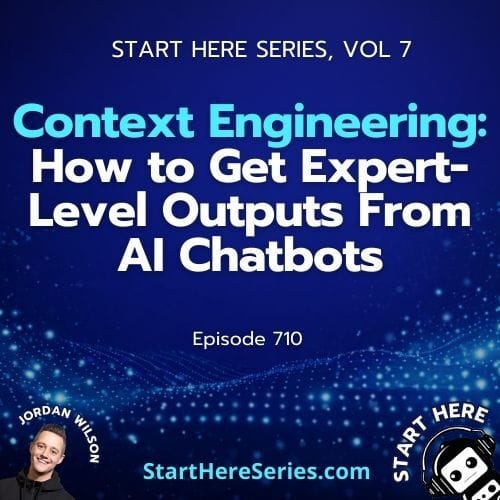
On today’s Start Here Series, we covered the transition from prompt engineering to context engineering.
Speaking of context, how have you (or your company) handled your company data and front-end LLMs?
Have you synced your company data with a LLM?🗳️ Vote to see LIVE results 🗳️ |
✌️
Jordan
Outsmart The Future
Today in Everyday AI
8 minute read
🎙 Daily Podcast Episode: The rules of LLMs are changing fast, but teams still cling to old prompting playbooks. Here’s how to adapt to context engineering. Give today’s show a watch/read/listen.
🕵️♂️ Fresh Finds: Google brings AI captions to Vids, Amazon looks to open an AI marketplace, Ring stirs controversy with new AI camera features, and more. Read on for Fresh Finds.
🗞 Byte Sized Daily AI News: OpenAI secures big court win, NVIDIA’s $53 billion AI play, ChatGPT ads go live and more. Read on for Byte Sized News.
💪 Leverage AI: The biggest unlock in AI right now isn’t a new model or a new prompt trick. It’s context, and most teams haven’t built it yet. Keep reading for that!
↩️ Don’t miss out: Miss our last newsletter? We covered: Report: ChatGPT getting new model this week, Super Bowl ads go all in on AI, Crypto.com makes big play with AI.com and more. Check it here!

Ep 710: Context Engineering: How to Get Expert-Level Outputs From AI Chatbots
How did prompt engineering die so quickly? ☠️
And what the heck does context engineering even mean?
One of the trickiest things about LLMs is they're changing daily, yet they're the engines that drive business results.
But if the engine is constantly changing, then you also have to change how you drive and the roads you take.
That's why we're tackling context engineering in this installment of our Start Here Series, the essential beginners guide to understanding AI basics and growing your skills.
Also on the pod today:
• Prompt engineering is dead? 💀
• Six building blocks breakdown 🧱
• Show, don’t tell, in prompts 👀
It’ll be worth your 37 minutes:
Listen on our site:

Click to listen
Subscribe and listen on your favorite podcast platform
Listen on:

Here’s our favorite AI finds from across the web:
New AI Tool Spotlight – Thesys Agent Builder Lets You Create AI apps that respond with charts, forms, cards and more, Normain Answers specific questions from documents. Reliably, Cosmic CLI is AI-Powered Content and Code Management from Your Terminal
Google Vids Captions — Google Vids lets you create and customize captions for any video. Want to see who gets access and how it works?
Anthropic Philosopher Training Claude — Amanda Askell is training Anthropic’s AI, Claude, to understand right from wrong and develop a strong, helpful personality.
Runway AI Video Fund — Runway raised $315 million at a $5.3 billion valuation, doubling down on AI video.
Ring Camera AI Feature — Ring’s new AI features claim to help find lost pets, but critics say it’s a clever cover for nationwide surveillance. Want to know what’s really happening?
EmbeddingGemma Tuning Labs — Google’s EmbeddingGemma Tuning Lab lets you experiment with embedding models right in your browser. Click to Learn More.
Seedance 2.0 Visual Test — Seedance 2.0 stuns with visuals rivaling Sora and Veo.
Amazon AI Marketplace — Amazon is eyeing a marketplace for publishers to sell content to AI firms. Microsoft wants in, too—what does this mean for the future of online content?
AI Stock Worry — Morgan Stanley says AI trading could shake the $15 trillion US credit market. Curious what’s at risk?
ChatGPT Deep Research Rollout — ChatGPT’s deep research features are expanding. Context engineering is unlocking better AI results.
Claude Interactive Responses — Claude now lets you interact with responses, not just type. Click to See how tool-based chats are evolving.

1. ChatGPT Begins Testing Ads for U.S. Users 🛒
OpenAI just kicked off a test to bring ads into ChatGPT for adult Free and Go users in the United States, marking a big shift for the popular chatbot.
Ads will be clearly labeled and separated from answers, with strict privacy measures to keep user conversations private and ad targeting limited. Users can opt out or upgrade to ad-free tiers, while feedback from this trial will shape the future of advertising in ChatGPT.
2. Google’s AI Drug Lab Eyes Major Breakthroughs 🧪
AI trailblazer Demis Hassabis and his team at Isomorphic Labs are making headlines as they ramp up efforts to revolutionize drug discovery, aiming to develop dozens of new medicines each year using advanced AI.
Backed by a new $600 million investment, the company is targeting diseases that have long stumped traditional pharma, promising to speed up the hunt for life-saving treatments. With partnerships in place and clinical trials on the horizon, Isomorphic is betting big that its tech can outpace rivals and turn the drug design process on its head.
3. Anthropic Eyes $20B Mega-Funding Amid AI Arms Race 🤑
Anthropic is reportedly closing in on a massive $20 billion fundraising round at a jaw-dropping $350 billion valuation, Bloomberg reports, as investor excitement pushes the company to double its funding target.
This rush to raise capital comes just months after Anthropic’s last $13 billion round, fueled by fierce competition and skyrocketing compute costs. With Nvidia and Microsoft leading the charge, alongside major venture firms, Anthropic’s latest innovations in coding and research models are shaking up both tech and data sectors.
4. OpenAI Scores Legal Win in Author Copyright Showdown ⚖️
A federal judge just handed OpenAI a major victory by reversing an earlier order that would have forced the company to reveal potentially damaging internal communications about deleted training datasets.
At the heart of the dispute are pirated books allegedly used to train older AI models, with authors like Sarah Silverman accusing OpenAI of copyright infringement and seeking massive damages. The latest ruling protects OpenAI’s attorney-client privilege and keeps discovery over its dataset deletions off-limits, dealing a blow to authors hoping to prove willful infringement.
5. TikTok’s Parent Unveils Next-Level AI Video Tool ⚒️
ByteDance, the company behind TikTok, just launched Seedance 2.0, a new generative AI video tool in beta that’s creating buzz for its shockingly realistic results and could soon shake up the global social media landscape.
While it’s not officially on TikTok yet, its advanced capabilities are generating speculation that it might soon outpace rivals like Meta and X in the AI content race, which is quickly becoming a high-stakes competition. The news comes as tech giants pour eye-watering sums into AI infrastructure, intensifying the pressure for profitable breakthroughs.
6. Databricks Bags $7B to Supercharge AI Push 💸
Databricks has just locked in a jaw-dropping $7 billion capital injection, including $5 billion in new funding at a $134 billion valuation, as it ramps up its AI ambitions for enterprise customers.
The company’s annualized revenue has soared to $5.4 billion, and its AI products alone are raking in $1.4 billion per year, making it one of the hottest names to watch in tech. With JPMorgan Chase leading the $2 billion debt financing, Databricks is staying private and doubling down on growth while rivals sweat public market swings.
7. Nvidia’s $53 Billion AI Power Play Shakes Up Tech Investing 💵
Nvidia has unleashed a $53 billion investment blitz across 170 deals since 2020, making huge bets on everything from AI model startups to chip design and quantum computing. In 2025 alone, the company backed nearly 70 ventures, dramatically ramping up its pace and influence across the entire AI ecosystem.
The strategy is simple: flood the field with capital so that no matter which AI technology or company takes the lead, Nvidia’s hardware stays at the center of the action.

Your company burned $500K on AI tools this year and your team is still getting outputs that sound like robotic em dashed love affairs.
The reason?
Nobody told you prompt engineering died in mid-2025 and context engineering is now all the rage.
Case in point?
Two people at competing companies type the exact same prompt into ChatGPT. Same words. Same model. One gets strategic analysis worth millions. The other gets trash.
The difference ain't the wording fam.
It's context.
Companies crushing it with AI figured out the bottleneck was never about how you talk to models. It was always about the information behind them. Gartner found 40% of AI projects fail purely from poor context, not bad prompts.
We broke this down on today's Everyday AI Start Here Series and laid out the six building blocks and four-layer system separating expert outputs from expensive paperweights.
If your team's still running prompt workshops, you're prolly two years behind.
1. How You Talk Doesn't Matter Anymore 🔥
Mid-2025 changed everything.
Tobi Lütke from Shopify called for moving from prompts to context. Same month, former OpenAI co-founder Andrej Karpathy endorsed it. By September, Anthropic published a whole blog ditching prompt engineering.
Why?
Models got smart enough that wording doesn't matter. You can misspell half your prompt and use trash grammar and today's AI still gets it.
Two years ago, prompt engineering was like having a secret password. Specific techniques like chain of thought unlocked way better outputs from GPT-3 than people who didn't know them.
Now?
Models do that heavy lifting by default.
What separates average outputs from expert-level strategic analysis is whether AI has your business data, competitive position, brand voice, and actual constraints before you start talking.
Context is the differentiator shorties.
Try This
Open ChatGPT or Claude right now.
What's connected? Google Drive? Slack? Company docs?
If the answer's no, you're getting generic outputs because AI knows nothing about your business. Spend 20 minutes this week connecting one data source with your company's real info.
Brand guidelines. Strategy docs. Anything.
Then ask a business question you normally ask. Watch how the answer changes when it knows context about your company instead of making assumptions that don't apply to your situation.
2. Six Blocks Build Expert Context ⚡
Most people upload random files and hope AI figures it out.
Wrong.
There's a systematic framework. Six specific building blocks working together.
Goal defines what you need AI to produce and for whom. Constraints set boundaries, rules, and format requirements. Reference material means approved facts and source documents. Examples show good outputs plus why they work. Procedures give step-by-step instructions. Evaluation rubric provides grading criteria.
But here's the gnarly part.
Apply these six blocks across four layers. Personal context about your role. Team context with shared definitions. Company context covering brand voice and policies. Market context including competitive position.
That's how the 1% structure their AI inputs fam.
Try This
Pick one weekly AI task and map all six blocks.
Write your goal. Your constraints. Examples of good outputs. How you'd grade quality.
Save it as a template. ChatGPT project. Claude skill. Google Doc. Whatever.
Next time you run that task, use your template instead of winging it.
You'll cut setup time in half and get outputs that sound like they came from someone who actually understands your business instead of generic garbage you have to rewrite anyway.
3. Build Vaults Before People Leave 🚀
That person on your team who knows how everything works?
They're thinking about retiring.
When they leave, all that knowledge walks out unless you capture it in a context vault now. Think reusable folders of procedures, rubrics, and key facts capturing how your business operates.
You wouldn't throw a manual at a new hire and say figure it out in an hour. You'd walk them through step by step, show examples, give feedback.
Same here.
Difference is these vaults scale infinitely. One vault powers dozens of AI implementations across your org.
Try This
Document one critical process living in someone's head.
Pick something that'd cause chaos if they quit tomorrow. Escalations. Pricing. Client onboarding.
Spend 30 minutes writing the step-by-step process, key decisions, and context needed to replicate it perfectly.
Save it where AI can access it.
Test it. Ask AI to walk through a scenario using that doc. You'll see what's missing immediately.
Fix those gaps before Linda retires and takes 20 years of knowledge to Arizona.
Reply